.webp)






The digital landscape of competitive gaming is often a battle against the invisible specter of latency. In the high-octane environment of Rematch, where victory is measured in milliseconds and spatial positioning is paramount, the developers didn't just build a game; they engineered a proprietary networking philosophy known as the Chronos-Sync Model. This isn't your standard client-side prediction or simple rollback netcode. It is a sophisticated, multi-layered temporal architecture designed to bridge the gap between disparate geographic locations, ensuring that the "shared reality" of the arena remains absolute.
To understand Rematch is to understand its obsession with the "True Frame." While most modern shooters rely on a server-authoritative model that can feel "floaty" or result in "getting shot behind walls," Rematch utilizes a deterministic lockstep evolution that treats time as a malleable resource. This article explores the intricate engineering, the philosophical underpinnings of its state-synchronization, and the cultural impact this technical feat has had on the professional meta-game.
1. The Genesis of the Deterministic Engine
In the early prototyping phases of Rematch, the engineering team realized that standard Unreal or Unity networking suites would be insufficient for the level of precision required. They pivoted toward a custom-built, deterministic engine where every input results in the exact same output across all clients, provided the initial seed and timing are identical. This shifted the burden of synchronization from "what happened" to "when it happened," allowing the game to function as a mathematical proof that unfolds in real-time.
The core of this engine is the State-Vector Matrix. Every player action—be it a micro-adjustment in aim or the deployment of a tactical utility—is converted into a high-density data packet. Unlike traditional games that send coordinate updates, Rematch sends the intent and the timestamp. The server doesn't tell the client where they are; it validates the physics of how they got there. This creates a foundation where the game world feels remarkably solid, as the physics engine is never "guessing" about player positioning.
The Logic of Hard-Coded Consistency
- Packet Homogeneity: Every data burst is exactly the same size to prevent jitter.
- Fixed Tick-Rate: The engine operates at a rigid 128Hz internal simulation, regardless of the user's frame rate.
- Seed Synchronization: Random elements (like bullet spread or environmental debris) are governed by a shared pseudo-random number generator initialized at the start of the match.
2. Temporal Anchoring and the Ghosting Protocol
One of the most radical features of Rematch is the Temporal Anchor. In most online games, your local character is slightly ahead of the server, and the enemies you see are slightly behind. Rematch solves this by implementing a "Ghosting Protocol" that essentially runs two versions of the game simultaneously on your hardware. One version is your immediate, predicted movement; the other is the "Anchor," which represents the confirmed reality of the server.
The genius of this system lies in how it handles the discrepancy. Instead of snapping the player back when a de-sync occurs, the Ghosting Protocol uses a linear interpolation algorithm to merge the two states over a period of three frames. This makes corrections invisible to the human eye. To the player, it feels like the game is anticipating their lag and smoothing out the wrinkles of the internet before they can even perceive them.
Components of the Anchor System
- Prediction Buffer: Stores the last 500ms of player inputs.
- Verification Gate: A server-side check that confirms if an input was physically possible.
- Visual Resolver: The layer that renders the smooth transition between the predicted and confirmed states.
3. The Geometry of the "True Frame"
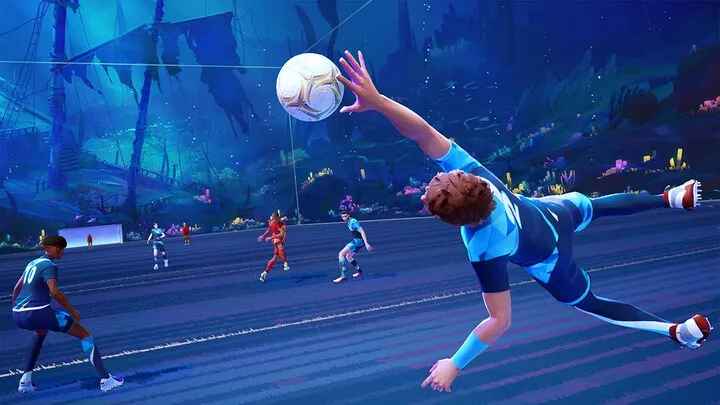
At the heart of the competitive integrity of Rematch is the concept of the True Frame. In professional play, players often complain about "peekers advantage," where a player moving around a corner sees their opponent before they are seen. Rematch attempts to eliminate this through Symmetric Latency Compensation (SLC). The game calculates the round-trip time (RTT) for all participants and artificially introduces a buffer so that the "True Frame"—the moment an encounter occurs—is rendered simultaneously for both players.
This specific focus on the geometry of sightlines means that the game’s environment is not just a collection of 3D models, but a grid of Validated Interaction Zones. When a player fires a shot, the game doesn't just check if the crosshair was on the target; it rewinds the entire world state to the exact millisecond of the "True Frame" to see if the hit was valid from the perspective of the physics engine.
4. Sub-Millisecond Input Sampling
To feed such a hungry deterministic engine, Rematch utilizes Sub-Millisecond Input Sampling. Most games poll your mouse and keyboard at the start of a frame. Rematch, however, decouples input from the rendering loop. It samples the HID (Human Interface Device) at a much higher frequency—up to 8000Hz for supported peripherals—and timestamps every micro-movement.
This means that if you flick your mouse in the middle of a frame, the game knows exactly when that movement started. It doesn't wait for the next "tick" to register the change in direction. This data is then packed into the Chronos-Sync stream, allowing the server to reconstruct the player’s movement with an accuracy that was previously only possible in local LAN environments.
Technical Breakdown of Sampling
- Raw Input Stream: Bypasses Windows OS pointer precision settings.
- Interrupt-Driven Polling: Ensures the CPU prioritizes game inputs over background tasks.
- Jitter Filtering: A software layer that removes the "noise" of cheap sensors without adding delay.
5. The Evolution of the Server-Side Arbiter
As Rematch moved from its beta phase into its first professional season, the Server-Side Arbiter (the SSA) became the most critical piece of software in the ecosystem. The SSA is an AI-enhanced oversight tool that monitors the health of the Chronos-Sync stream. It doesn't just act as a referee; it acts as a sculptor of the network environment. If the SSA detects that a specific node in the global network is experiencing packet loss, it can dynamically reroute the data through a faster "Express Lane."
This "Express Lane" is a result of the developers' partnerships with global Tier-1 ISPs. By using Anycast IP routing, Rematch ensures that a player’s data travels the shortest physical path to the server. The SSA monitors these paths in real-time, switching routes mid-match if it detects a spike in congestion. This level of infrastructure is what allows Rematch to maintain its "LAN-like" feel even when players are hundreds of miles apart.
6. Collision Resolution in a Latency-Free Environment
In high-speed games, the most difficult thing to sync is the collision between two moving players. Most games handle this poorly, resulting in "teleporting" or players getting stuck inside one another. Rematch uses a Spatial Partitioning Algorithm that predicts potential collisions before they happen. By calculating the trajectories of all players within a certain radius, the engine creates "Soft Colliders" that gently nudge players apart if their paths are set to intersect in the next 100ms.
This proactive approach to physics ensures that the movement feels fluid and "greased." You never feel the jarring stop of hitting another player’s hitbox in a way that feels unfair. Instead, the Chronos-Sync model ensures that both players' clients agree on the point of contact simultaneously, preserving the momentum and the "flow state" that is so vital to the Rematch experience.
7. The Impact of Chronos-Sync on Professional Meta-Tactics
The extreme reliability of the networking in Rematch has fundamentally changed how the game is played at the highest levels. In other titles, certain tactics are avoided because they are "ping-dependent." In Rematch, the technical barriers are stripped away, leading to the rise of Precision Peeking and Frame-Perfect Utility.
Professional teams now practice maneuvers that require 1/60th of a second timing, knowing that the engine will execute them perfectly. This has led to a meta-game that is much more aggressive than its predecessors. When players know they won't be "robbed" by a lag spike, they are more willing to take high-risk, high-reward plays. The reliability of the hit registration has turned every match into a pure test of skill, rather than a test of who has the better internet connection.
Shift in Meta Trends
- The Death of the "Lag-Shield": Defensive players can no longer rely on jitter to make themselves harder to hit.
- Aggressive Utility Buffering: Players can "stack" abilities with micro-second gaps to create overwhelming pressure.
- Synchronized Executes: Teams can time their entries from different sides of a map with perfect coordination.
8. Data Compression and the "Thin-Pipe" Philosophy
Despite the massive amount of data required to maintain a deterministic 128-tick state, Rematch is surprisingly efficient. The engineering team adopted a "Thin-Pipe" Philosophy, utilizing a custom compression algorithm called Delta-Bit Packing. Instead of sending the full state of the player, the client only sends the "delta"—the difference between the current frame and the last confirmed frame.
This reduces the bandwidth requirement by nearly 70%, allowing players with sub-optimal internet speeds to compete on a level playing field. The Delta-Bit Packing is so efficient that the game can maintain its high-fidelity simulation on a connection as slow as 1 Mbps, provided the latency is stable. This accessibility has been a key factor in the game's rapid global adoption, particularly in regions where high-speed fiber is not yet ubiquitous.
9. Security and Anti-Tamper Integration within the Stream
A unique byproduct of the Chronos-Sync model is its inherent resistance to certain types of cheating. Because the engine is deterministic and every input must be validated against a physics-based "Verification Gate," traditional "Speed Hacks" or "Teleport Hacks" are physically impossible. If an input doesn't follow the laws of the game's physics, the server simply discards it, and the player's client is resynced to the last valid state.
Furthermore, the Input Stream is Encrypted with a rotating key that changes every few seconds. This prevents "Packet Injection" attacks where a third-party program tries to send fake "perfect aim" data to the server. By weaving security directly into the networking fabric, Rematch has created an environment where the "sanctity of the frame" is protected from the ground up, rather than being patched in as an afterthought.
10. The Future of Temporal Networking
The success of the Chronos-Sync model in Rematch has set a new benchmark for the industry. Moving forward, the developers are looking into Neural-Link Prediction, where machine learning models are used to predict a player's likely movement based on their historical playstyle during brief moments of total packet loss. While still in the experimental phase, this represents the next frontier of temporal networking—using AI to fill the gaps in human connectivity.
As we look at the legacy of Rematch, it is clear that its contribution isn't just in its art style or its character design, but in its refusal to accept the limitations of the internet. By treating time as a variable to be mastered rather than a hurdle to be jumped, Rematch has redefined what it means to play together in a digital space. The Chronos-Sync model is more than just code; it is a promise of a fair, consistent, and perfectly synchronized competitive future.
Conclusion
In the final analysis, Rematch’s Chronos-Sync networking isn't merely a technical achievement—it’s a paradigm shift in how we perceive online interaction. By dismantling the traditional barriers of latency and de-sync, the game provides a pure, unadulterated arena for human skill. The "True Frame" isn't just a marketing buzzword; it is a mathematical reality that ensures every shot fired and every move made is recorded with absolute fidelity. As the industry moves forward, the blueprints laid down by the Rematch engineering team will likely serve as the foundation for the next generation of online experiences, proving that in the world of high-stakes gaming, time is the ultimate weapon.